
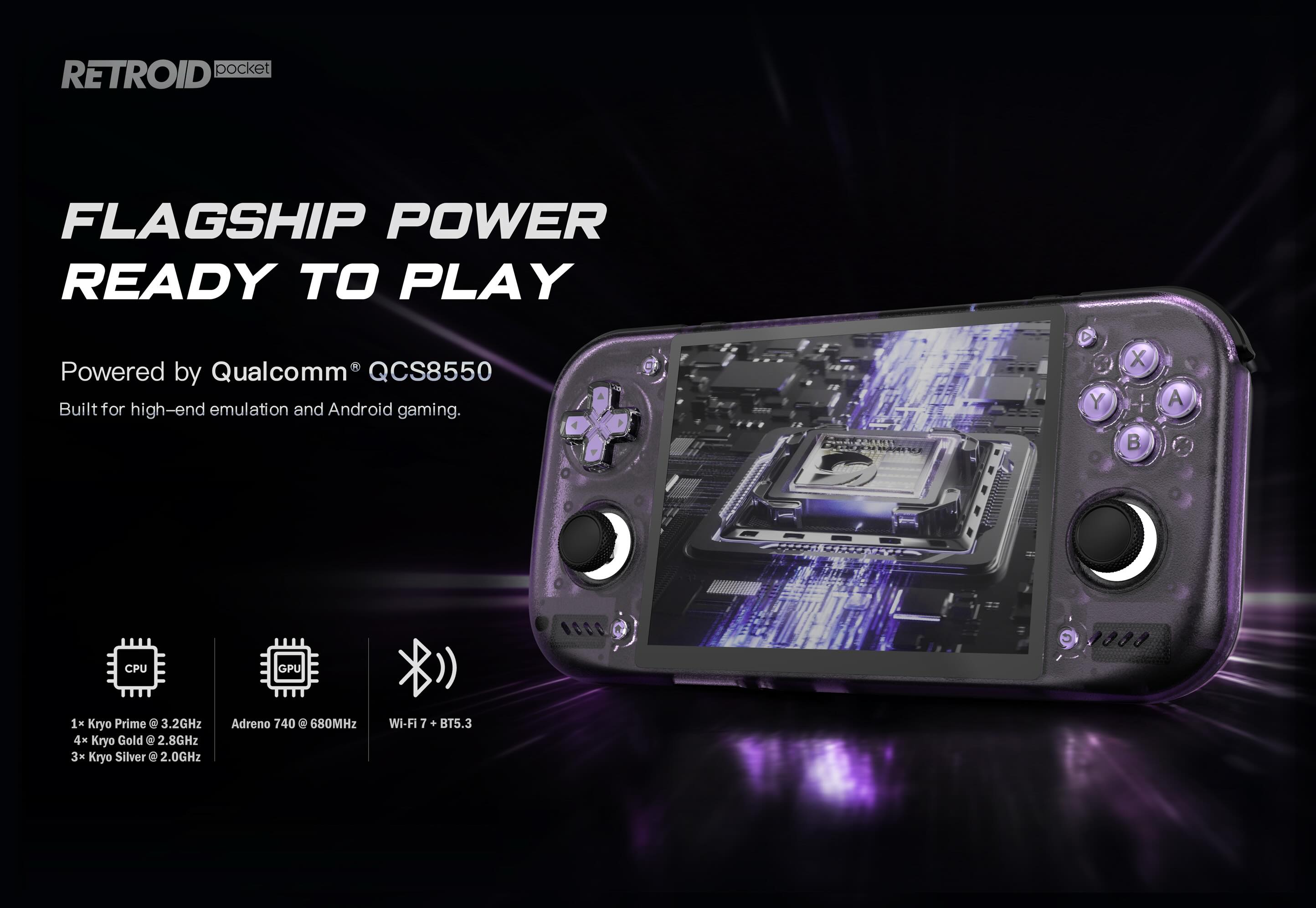
What Is the Pocket Nova?
The Retroid Pocket Nova is Retroid's newest horizontal handheld, and it's a clear shot at the flagship tier. Instead of the mid-range chips we've seen in most of the Pocket line, the Nova runs a Qualcomm QCS8550 — which is essentially a Snapdragon 8 Gen 2 from the likes of the Retroid Pocket 6, AYN Thor, and Odin 2 line of devices — paired with a 4.5-inch 120Hz AMOLED display, active cooling, and a 5,000mAh battery.
In short: this is built for the stuff that usually chokes cheaper handhelds. Think Switch and PS2 with headroom to spare, a serious run at GameCube and Wii, and even native Android gaming at high frame rates. It ships on Android 13 and stays true to Retroid's "open to everything" approach — emulation frontends, PC game launchers like GameHub and GameNative, streaming apps, you name it.
Full Specifications
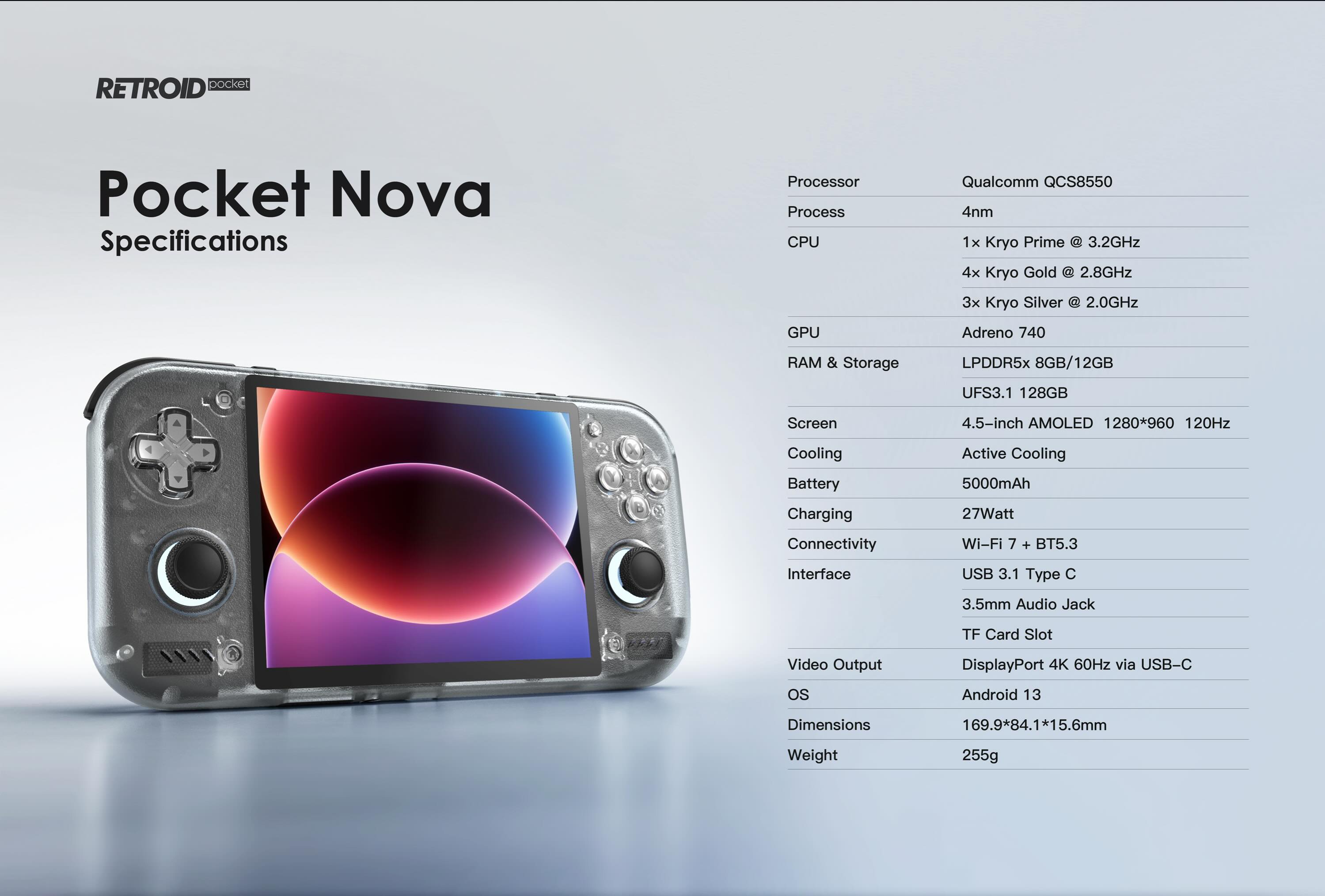
| Processor | Qualcomm QCS8550 |
|---|---|
| Process | 4nm |
| CPU | 1× Kryo Prime @ 3.2GHz · 4× Kryo Gold @ 2.8GHz · 3× Kryo Silver @ 2.0GHz |
| GPU | Adreno 740 |
| RAM & Storage | LPDDR5x 8GB / 12GB · UFS 3.1 128GB |
| Screen | 4.5-inch AMOLED · 1280×960 · 120Hz |
| Cooling | Active cooling |
| Battery | 5000mAh |
| Charging | 27W |
| Connectivity | Wi-Fi 7 + BT 5.3 |
| Interface | USB 3.1 Type-C · 3.5mm audio jack · TF card slot |
| Video Output | DisplayPort 4K 60Hz via USB-C |
| OS | Android 13 |
| Dimensions | 169.9 × 84.1 × 15.6 mm |
| Weight | 255g |
The 4.5-inch AMOLED at 1280×960 is a 4:3 panel — perfect for retro consoles that were designed for that aspect ratio. Add 120Hz and you get deep blacks for OLED-friendly libraries plus smooth motion for native games.
Choose Your Color
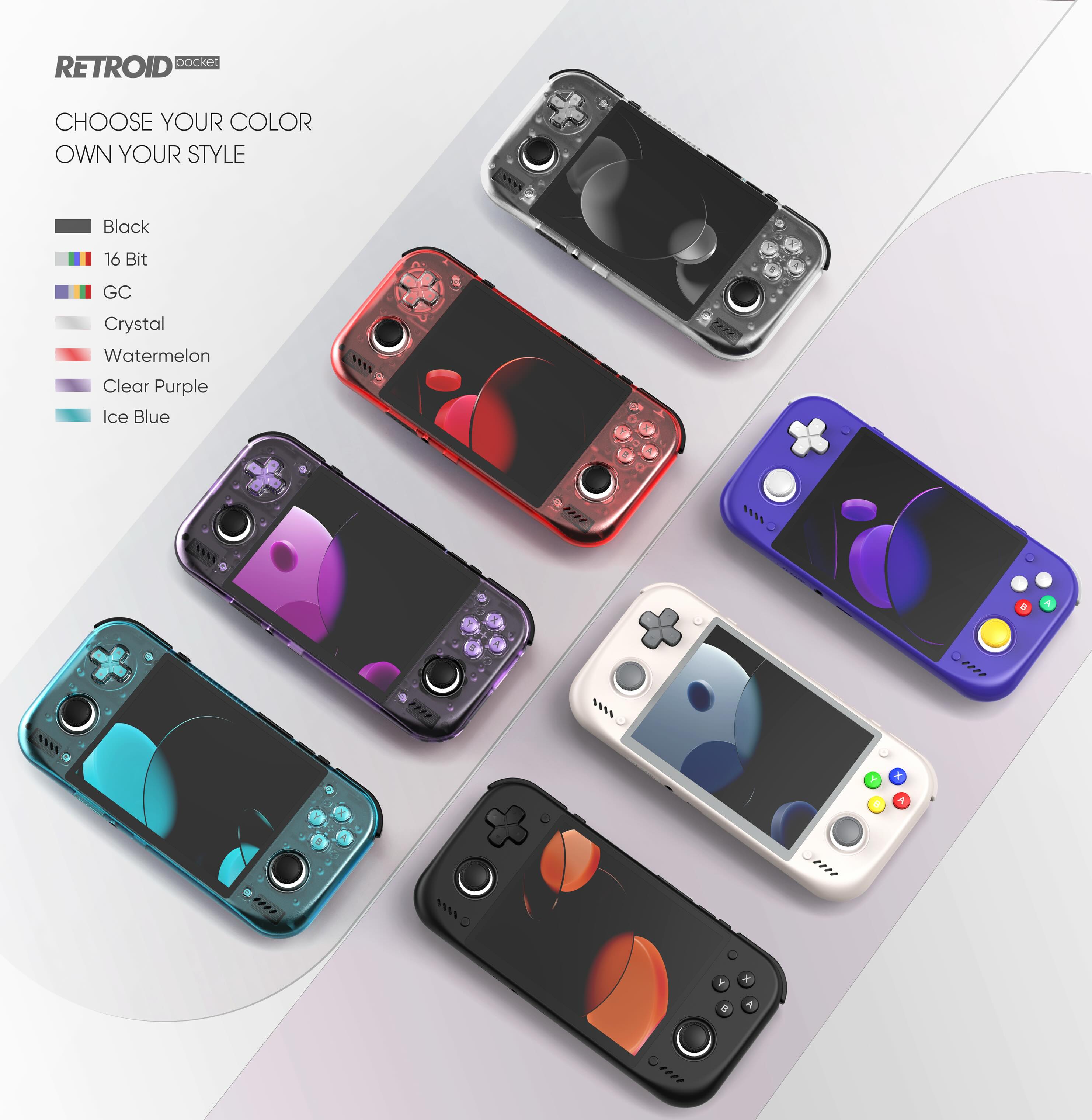
The Nova launches in seven finishes, mixing solid shells with Retroid's signature translucent looks.
The translucent shells (Crystal, Watermelon, Clear Purple, Ice Blue) lean into that retro see-through aesthetic, while 16 Bit and GC are clear nods to classic console color schemes. Note that the colorway you pick affects the price — more on that below.
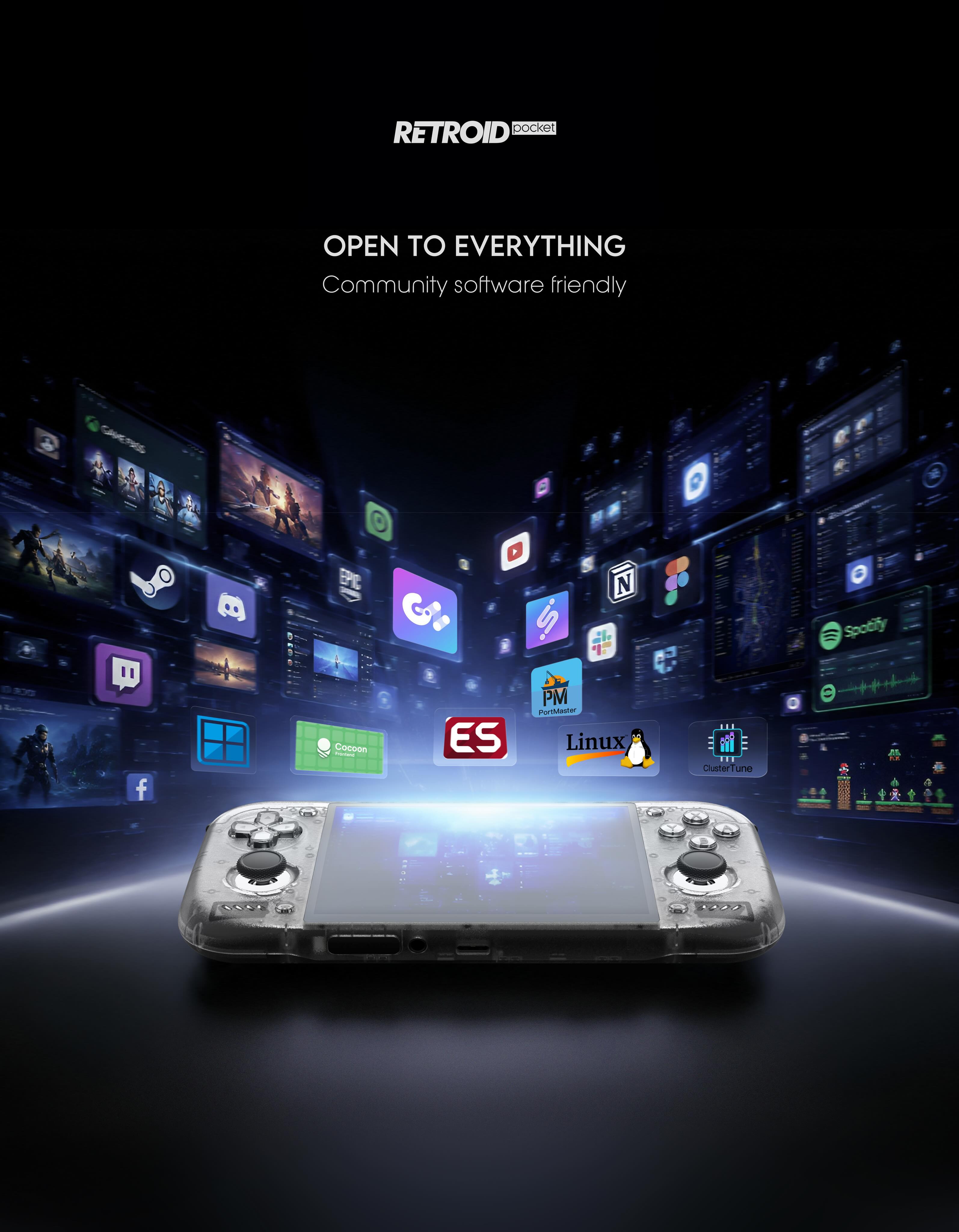
Open to Everything
Because the Nova runs Android 13, you're not locked into a single launcher or ecosystem. Out of the box it's friendly to the whole community-software stack that makes these handhelds so flexible:
- Emulation: Expect everything from old retro games up to Switch 1 to run very well. PS2 and GameCube should run beautifully on the Nova.
- PC games: GameHub and GameNative will allow the Nova to run many PC games. Lightweight indie games and games from the early 2010s should run well. Newer more demanding games will struggle but some will be playable with tweaks. Expect to be able to play games up to the likes of Skyrim and GTA V. Demanding games like Elden Ring and Cyberpunk 2077 will remain slightly out of reach.
- Streaming: GeForce NOW and Xbox Game Pass will be great for those higher-end games. Local PC streaming using Artemis & Apollo will also work great.
- Everyday apps: YouTube, Discord, music players — it's still a full Android device after all!
That openness is the whole point of the Pocket line, and the Nova's flagship chip means even demanding streaming and high-end emulators have the horsepower to keep up.
Price & Pre-Order
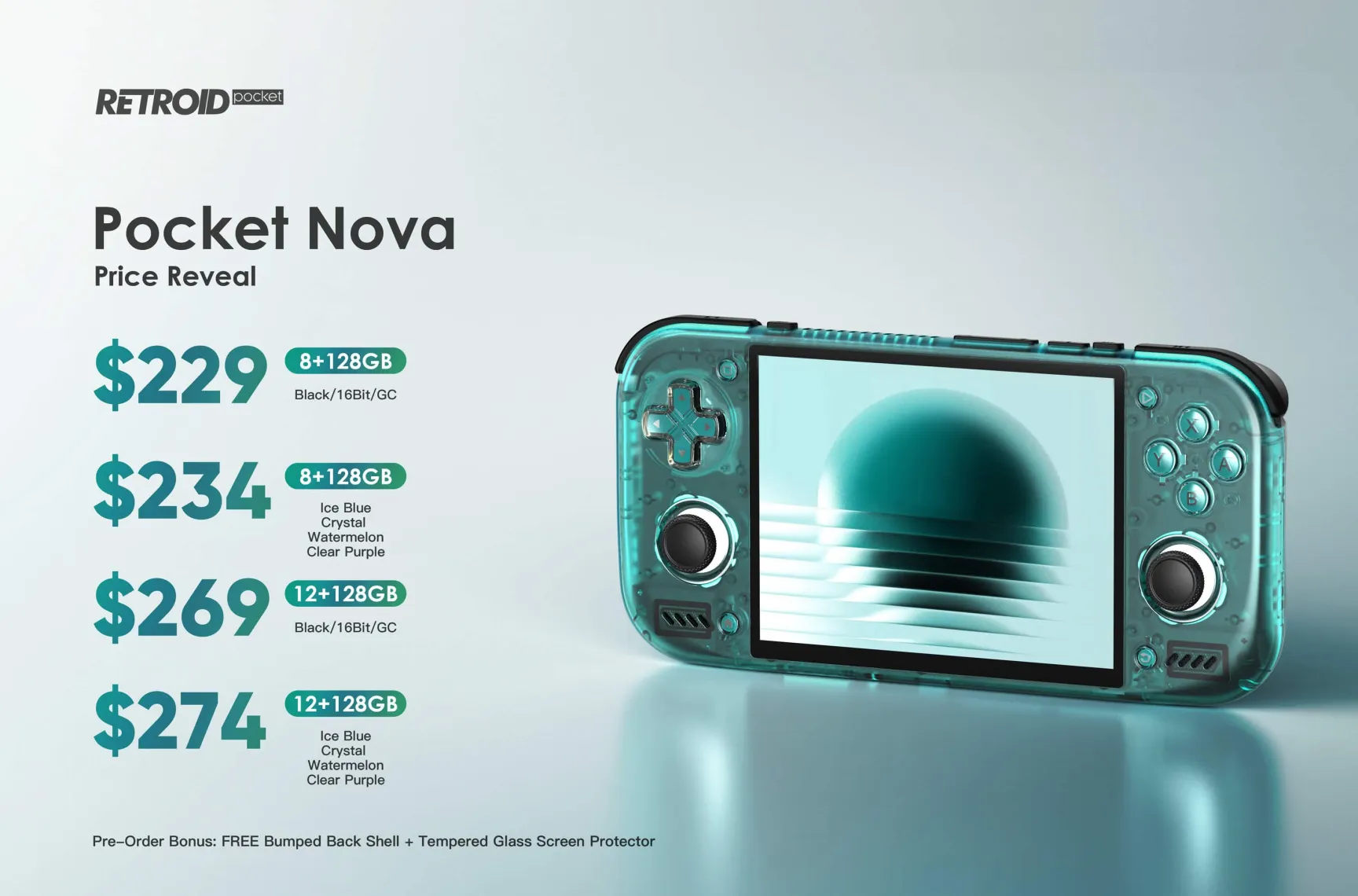
Here's where the Nova gets interesting. Flagship power usually means flagship pricing — but the Nova starts at $229.
Pre-Order Bonus: a FREE bumped back shell + tempered glass screen protector. Bundling those in is a nice touch for early buyers.
The jump from 8GB to 12GB of RAM is only $40, and the translucent colorways add a small $5 premium over the standard 12GB models. For high-end emulation and Android gaming, the extra RAM is worth it — that's the config I'd point most people toward.
Should You Buy It?
On paper, the Pocket Nova is one of the most exciting handhelds Retroid has put out. A flagship QCS8550, a 4:3 120Hz AMOLED, active cooling, and a 5,000mAh battery — starting at $229 — is an aggressive package. If you've been waiting for a Retroid that can confidently push past PS2 into GameCube, Wii, Switch, and high-end Android, this is the one to watch.
As always, I'd hold final judgment until we see how it performs in real-world testing — thermals under sustained load and emulator compatibility are what separate a great spec sheet from a great handheld. I'll have full benchmarks and a hands-on review on the channel, so subscribe if you want to see how it actually plays before you commit.
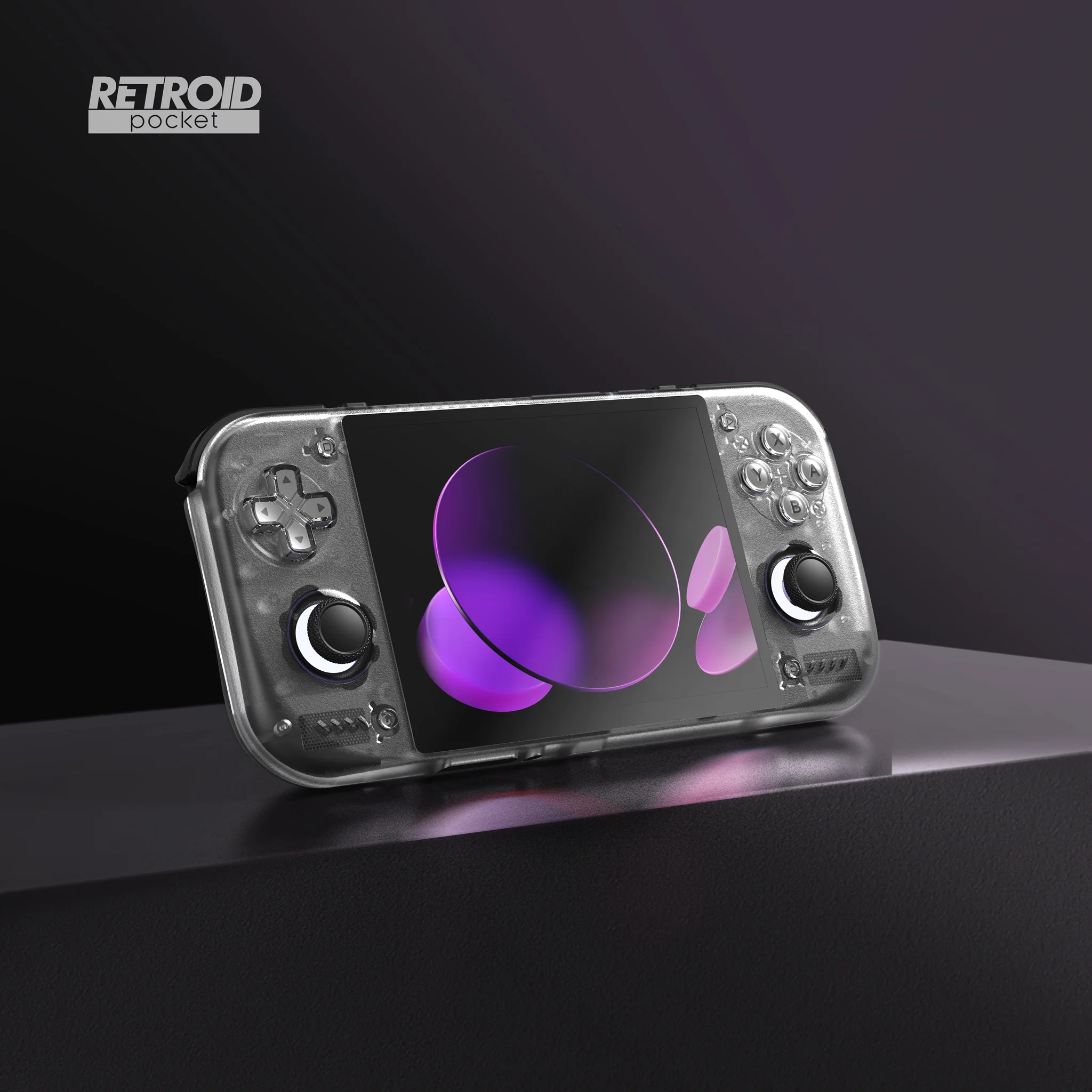
Retroid Pocket Nova
Flagship QCS8550 · 4.5″ 120Hz AMOLED · seven colorways
This is an affiliate link which supports me at no extra cost to you! Thank you very much if you use it ❤️